What Happens When Language Isn’t Enough?
Language is often seen as the strongest connection to culture. It carries stories, traditions, humor, and identity. But for many second- and third-generation immigrants, language can also become a source of pressure, disconnection, and even shame.
So what happens when someone feels deeply connected to their culture—but doesn’t feel fluent enough to “belong”?
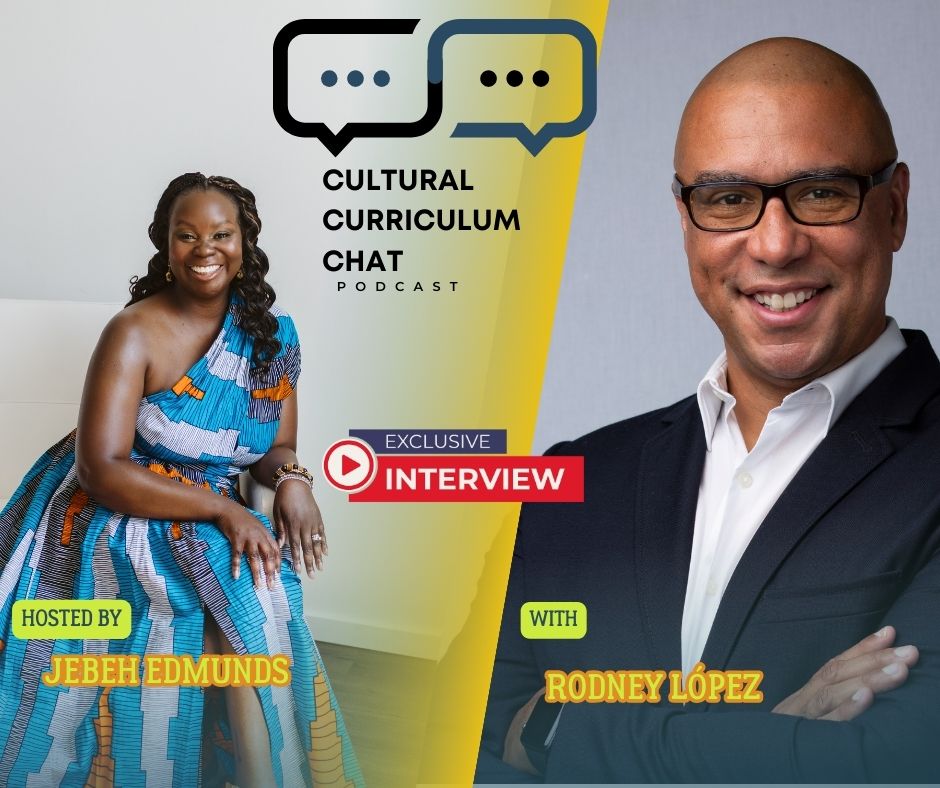
In this powerful episode of The Cultural Curriculum Chat Podcast™, host Jebeh Edmunds sits down with educator, artist, and nonprofit leader Rodney Eric López to explore the intersection of language shame, identity, dance, and cultural belonging.
This conversation is a must-read (and listen) for educators, parents, and anyone navigating cultural identity in multicultural spaces.
Rodney Eric López: Bridging Culture, Arts, and Education
Rodney Eric López has built a career at the intersection of arts education, cultural identity, and community leadership. As the CEO of Rodney Eric Lopez Enterprises, he has dedicated his work to helping people connect to culture through creative expression.
He was also featured in the acclaimed documentary
🎬 Mad Hot Ballroom, which showcased how dance education transformed the lives of New York City public school students.
That experience reinforced a powerful truth:
The arts are not just creative outlets—they are forms of communication.
Rodney explores this deeply in his forthcoming memoir, I Don’t Speak Spanish, but I Understand Everything When I’m Dancing, where he reflects on identity, belonging, and the emotional impact of language shame.
What Is Language Shame? (And Why It Matters)
Language shame is a common yet under-discussed experience in immigrant communities.
It often shows up as:
Feeling embarrassed for not speaking a heritage language fluently
Being told you’re “not really part of the culture”
Navigating pressure between assimilation and cultural preservation
For many young people, this creates a painful in-between space:
Not fully accepted in dominant culture
Not fully accepted in their heritage culture
Rodney highlights how these experiences shape identity and self-worth—especially for students in classrooms across the U.S.
Why Educators Should Pay Attention
Understanding language shame is essential for:
Building culturally responsive classrooms
Supporting multilingual learners
Affirming student identity beyond language ability
Salsa as a Cultural Language
For Rodney, the answer to language disconnection came through dance—specifically Salsa.
Within the Nuyorican community, Salsa is more than movement—it’s history, identity, and storytelling.
How Dance Becomes Language
On the dance floor:
Rhythm replaces words
Movement expresses identity
Connection builds community
Dance becomes:
A nonverbal language of belonging
A way to access cultural memory
A space where identity is felt, not judged
When words fall short, culture still speaks.
Why Arts Education Is Essential (Not Optional)
One of the most powerful takeaways from this conversation is the role of arts in education.
Too often, schools treat the arts as secondary. But Rodney’s work proves they are critical for:
Identity development
Confidence and self-expression
Cultural awareness
Social-emotional learning
What Students Gain Through the Arts
Students involved in arts programs develop:
Stronger communication skills
Increased engagement in learning
A deeper connection to their cultural identity
For students navigating language barriers or cultural tension, the arts provide something traditional academics often cannot:
👉 A way to be fully seen and understood.
Race, Language, and Latino Identity
Another key theme in this episode is the complexity of identity within Latino communities.
Latino identity is not monolithic—it includes a wide range of:
Racial identities
Cultural backgrounds
Language experiences
Rodney emphasizes that:
Language does not define authenticity
Culture exists beyond fluency
Belonging should not be conditional
This insight is critical for educators, leaders, and institutions working toward equity and inclusion.
Parenting, Culture, and Identity
For parents, especially in immigrant or multicultural households, preserving culture can feel challenging—especially when language barriers exist.
Rodney offers a powerful reframe:
Language is only one pathway to culture.
Ways to Preserve Culture Beyond Language
Families can nurture cultural identity through:
Music and dance
Food traditions
Storytelling
Cultural celebrations
Community connection
These experiences allow children to:
Feel rooted in their identity
Build pride in their heritage
Understand culture as something lived—not tested
Culture Is Bigger Than Language
This conversation reminds us of a powerful truth:
Culture is not something you have to prove—it’s something you live.
It exists in:
Movement
Music
Memory
Community
Expression
For educators, this means expanding how we define cultural competence.
For parents, it means releasing pressure and embracing creativity.
For individuals, it means reclaiming identity—on your own terms.
Listen to the Full Episode 🎧
Ready to dive deeper into this powerful conversation?
👉 Listen to Season 9, Episode #2: Language Shame, Identity, and the Power of Salsa with Rodney Eric López on The Cultural Curriculum Chat Podcast™