When we watch an international news report, we tend to focus on the person standing in front of the camera.
The correspondent.
The interview.
The images coming from a conflict zone.
The breaking-news headline.
But what happens before that camera starts rolling?
Who finds the sources? Who navigates the language? Who understands the cultural nuances? Who knows which questions to ask—and which questions may completely miss the mark?
And perhaps most importantly: Who helps an international journalist understand the people and places they are reporting on?
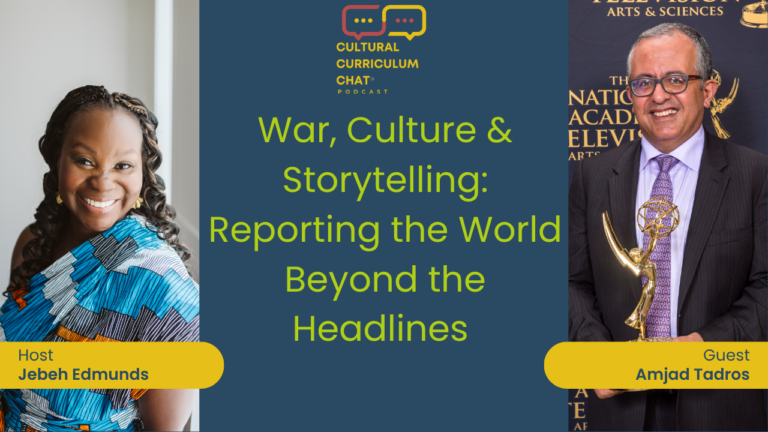
On this episode of The Cultural Curriculum Chat™, I had the opportunity to explore those questions with Amjad M. Tadros, an Emmy Award-winning journalist, author, and former Middle East producer for CBS News and 60 Minutes.
Amjad spent more than three decades working behind the scenes of international journalism, helping correspondents navigate wars, political upheavals, terrorism, and major global events throughout the Middle East.
His memoir, The Fixer: A Journalist’s Accidental Journey Through the Middle East, shines a light on a role that most viewers never see.
What Is a Fixer?
The word “fixer” may sound simple.
But the role is anything but.
A fixer can serve as a translator, researcher, cultural guide, producer, connector, problem-solver, and trusted local resource for international journalists.
They help reporters understand the environment they’re entering.
And that requires more than translating words.
It requires understanding context.
A phrase may have a completely different meaning depending on the cultural or political circumstances surrounding it. A gesture may communicate something that doesn’t translate directly into another language.
A relationship with a source may depend on trust that has taken years to build.
That cultural knowledge can make the difference between simply reporting what happened and actually understanding what happened.
Who Gets to Tell the Story?
This question is at the heart of my work in cultural competency.
Who gets to tell the story?
And whose perspective is missing?
When we report on another culture, country, or community, it can be easy to reduce complicated people and histories into simple narratives.
Good versus bad.
Victim versus villain.
Us versus them.
But real life rarely fits neatly into those categories.
Amjad’s experiences remind us that international journalism requires journalists to navigate not only physical geography but also cultural geography.
You have to understand the history.
The relationships.
The language.
The traditions.
The political realities.
And the lived experiences of the people whose stories you’re telling.
Without that context, even a technically accurate story can leave audiences with an incomplete understanding.
The Human Being Behind the Headline
One of the things that stood out to me in our conversation was the human element of journalism.
Wars and political conflicts are often presented through statistics, maps, military strategies, and breaking-news updates.
But behind every headline are people.
Families.
Communities.
Individuals whose lives are being changed by events they may not have chosen.
Journalists and fixers have the difficult responsibility of documenting those experiences while navigating safety, ethics, access, and accuracy.
That makes storytelling an enormous responsibility.
Journalism Has Changed. So Have We.
Amjad has witnessed extraordinary changes in journalism.
He worked during an era when television news and satellite broadcasting dominated international coverage.
Today, information moves through social media, podcasts, livestreams, smartphones, and artificial intelligence.
We can now receive information from around the world almost instantaneously.
That accessibility can be powerful.
But speed doesn’t always equal understanding.
In fact, the faster information moves, the more important media literacy becomes.
Before we share a video, repost a headline, or form an opinion about an international conflict, we should pause and ask:
Who created this information?
What perspective does it represent?
What context might be missing?
Whose voice isn’t included?
What assumptions am I bringing to this story?
Those questions aren’t just useful for journalists.
They’re useful for all of us.
What AI Means for Storytelling
Artificial intelligence introduces another layer to this conversation.
AI can generate text, images, audio, and video at remarkable speed.
But technology cannot automatically provide cultural understanding.
A machine can process information.
That doesn’t necessarily mean it understands the human context behind that information.
As journalism continues to evolve, the ability to distinguish information from understanding may become one of the most important skills we can teach.
Especially to young people.
Especially to students.
And especially to anyone navigating today’s media environment.
What This Means for Educators
This conversation connects directly to the work we do in classrooms.
Culturally responsive education isn’t only about what books we put on a reading list or which historical figures we introduce to students.
It’s also about teaching young people how to understand stories.
When students encounter a story about another culture, we can encourage them to ask:
Who is telling this story?
Whose voice is represented?
Whose voice is missing?
What cultural context do I need?
What assumptions am I making?
Is there another perspective I should consider?
Those questions help students move from simply consuming information to critically engaging with it.
And that’s a skill they’ll need far beyond the classroom.
A Story Is More Than a Headline
My conversation with Amjad Tadros reminded me that stories don’t exist in isolation.
They exist within cultures.
Within histories.
Within communities.
And within relationships.
The next time you watch an international news report, I encourage you to look beyond the person standing in front of the camera.
Think about the people behind the story.
Think about the cultural context.
Think about whose voice you’re hearing—and whose voice you aren’t.
Because understanding another person’s story requires more than knowing what happened.
It requires us to understand the people behind it.
Listen to the Conversation
Listen to my full conversation with Amjad Tadros on The Cultural Curriculum Chat™ as we discuss journalism, culture, the Middle East, storytelling, media literacy, AI, and his memoir, The Fixer: A Journalist’s Accidental Journey Through the Middle East.
And if this conversation made you think differently about the stories you consume, share this episode with someone who needs to hear it.
Continue the Conversation
Want more conversations about culture, identity, education, storytelling, and belonging?
Visit jebehedmunds.com and connect with me through The Cultural Curriculum Chat™ and Jebeh Cultural Consulting.
Keep learning. Keep questioning. Keep having the conversations that help us understand one another.